


The Ethics of a Product Promise
Who protects the end user?
When Product Claims Can Become an End Users Biggest Nightmare
Case in Point
As one would expect, DPL Labs relies on high-performance test instruments to evaluate and certify high-speed digital products. We continually upgrade our equipment to improve accuracy, efficiency and the level of service we provide to our clients. But sometimes, even the process of upgrading our own laboratory equipment reveals a much bigger problem affecting the industry and the end users who purchase its products.
Our latest addition was a new LG 32-inch 4K display monitor, selected to provide a substantial improvement in how we examine signals and waveforms at an evaluation level. Its USB-C interface promised a cleaner, more efficient installation with fewer cables and a simpler connection to our system. The specifications looked right. The technology was there. Everything appeared straightforward. There was just one problem:
The display wouldn’t work!
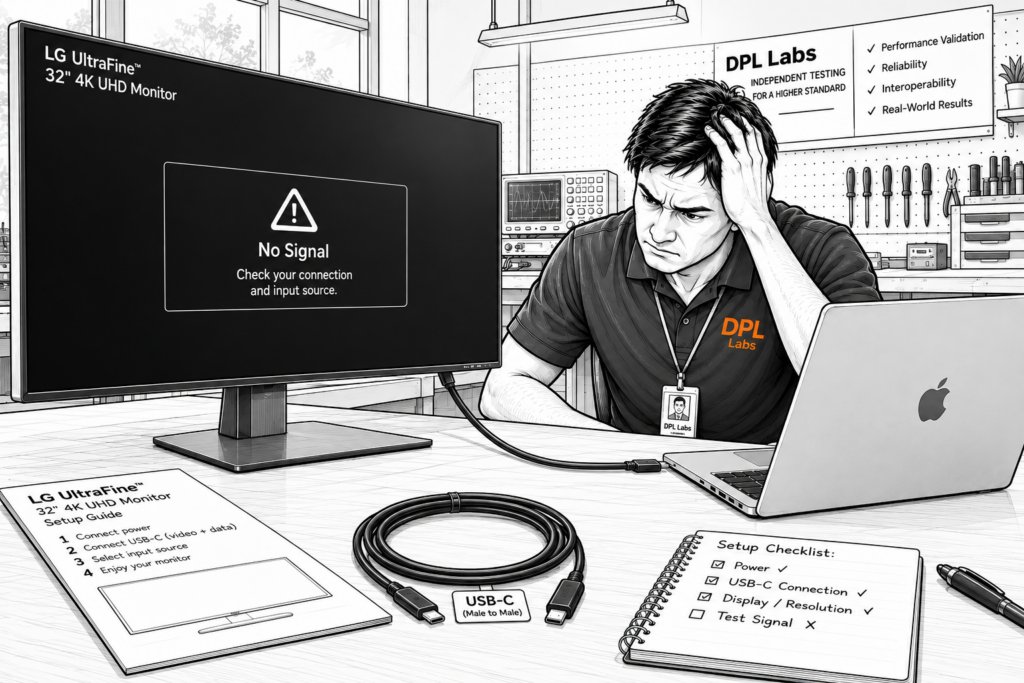
Engineer troubleshooting a monitor connection issue in the DPL Labs testing facility.
What followed was an unexpectedly frustrating exercise in troubleshooting. We checked connections, examined the setup and repeatedly investigated what could possibly be preventing the system from communicating with the display. Eventually, we decided to try what seemed like the simplest solution, replace the USB-C cable.
After trying seven different USB-C cables, we finally found one that brought the display to life. Interestingly, the successful cable had only a “4K” printed on the jacket with no other identifying markings, no recognizable brand, no impressive marketing claims, testing company identification and no cosmetic features that distinguished it from the others. It simply worked.
Consider what had just happened. A sophisticated laboratory system, designed to evaluate some of the industry’s most demanding high-speed digital products, had been brought to a standstill by an ordinary cable. The monitor wasn’t defective. The computer wasn’t defective. The problem was that the cables we initially tried did not provide the capabilities required to establish the connection. Further study DPL Labs discovered that the cables we tried did not have the power delivery requirements for the LG. Now consider what this means for the average end user.
We had the technical knowledge, the equipment and the experience to investigate the problem. We could methodically troubleshoot the system, isolate the connection and eventually identify the missing link. But what happens when the same situation occurs in someone’s home or business?
Imagine purchasing a new 4K display, a high-performance laptop or an expensive home theater component. You connect everything using a cable advertised as supporting 4K video. The connectors fit, the packaging makes impressive promises, and the product description leaves little doubt about its capabilities. Naturally, the end user expects it to work as advertised. But what happens when it doesn’t?
Here is the problem: without credible, independent performance validation, how can the end user know those claims are genuine? A manufacturer’s specification is a statement of intent, not necessarily proof of performance. Unless a product carries a recognizable testing organization, supported by actual performance evaluation, end users are being asked to accept those claims largely on faith. And when performance falls short, it is the end user who pays the price.
What are you supposed to do next? Is the display defective? Is the computer incompatible? Is there a software problem? Or is the cable simply incapable of delivering what its marketing claims suggest? Most end users have no practical way of knowing. They may spend hours trouble shooting and searching online, contact technical support, return perfectly good equipment or purchase additional products in an attempt to solve a problem that should never have existed in the first place. Some may eventually give up, accepting that their expensive equipment simply doesn’t work as expected. This is where the real vulnerability begins.
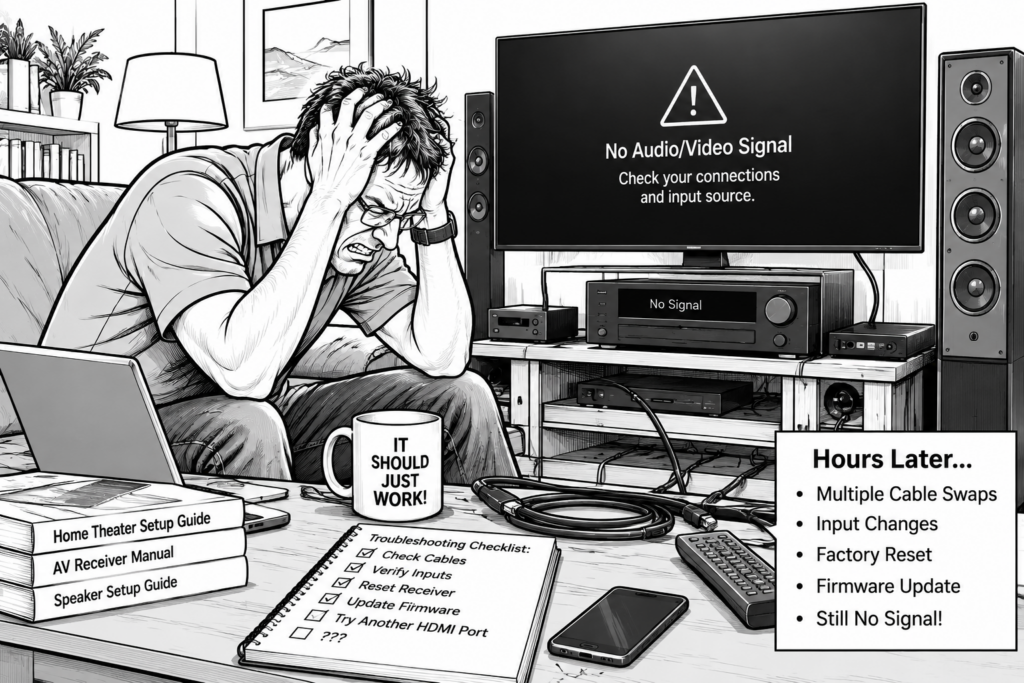
The consequences of unsubstantiated performance claims: a frustrated user dealing with a lack of audio/video signal, surrounded by troubleshooting guides and devices.
End users are being asked to make purchasing decisions based on performance claims they cannot independently evaluate. They generally don’t have the instrumentation, technical knowledge or resources to determine whether a product actually delivers what its manufacturer advertises. They rely on the integrity of those claims, assuming that someone, somewhere, has independently established that the product performs as advertised. But has anyone actually verified it? And more importantly, does it really perform as promised?
A USB-C connector fitting into a port proves only that the physical connection is possible. It does not establish that the cable supports the required video protocols, bandwidth, power delivery or other functional requirements. A product description can make impressive promises, but without meaningful performance validation, those promises may offer far less assurance than end users believe.
It is the fox guarding the hen house.
And this problem extends well beyond USB-C. It affects HDMI cables, Display Port, adapters, signal extenders, connectivity products and virtually every category of high-speed digital equipment. As technology becomes more complex, the distance between what a product claims and what it actually delivers can become increasingly difficult for end users to recognize.
The consequences are not always dramatic, like “my television doesn’t work”. Sometimes they appear as an intermittent connection, an unexpected loss of resolution, unreliable operation or a feature that never performs as advertised. Individually, these may seem like minor inconveniences. Collectively, they represent a much larger problem: end users paying for capabilities they may never receive.
Our experience at DPL Labs is a reminder that even experienced professionals can encounter these problems. The difference is that we have the resources to investigate and rectify them. Most end users do not. Product claims should mean something. Performance should be demonstrated, not assumed.
If manufacturers expect end users to trust their specifications, there must be a meaningful commitment to establishing that those specifications reflect actual product performance. Independent performance validation is not simply an engineering exercise or another step-in product development. It is an important safeguard between what manufacturers promise and what consumers ultimately receive.
This happens thousands of times every day across countless products and applications. And chances are, it has happened to you.
So, here’s the question: When a product doesn’t perform as advertised, who is responsible for the difference between what was promised and what the consumer actually received?
What if the greatest threat to product performance
wasn’t just poor engineering.
Instead
It was the Fear of Discovering its Truth!
Engineering Beyond the Fear Factor
For more than two decades, independent product testing laboratories around the world have served an important role in the advancement of consumer electronics. Whether evaluating USB products, networking equipment, audio/video interface products and systems (HDMI®/DisplayPort), or other electronic devices, the purpose has always remained the same:
To determine how a product’s actual performance compares with its specified requirements!

The reluctance of some manufacturers to engage in independent product testing despite the benefits of engineering support, guidance, retesting, and corrective assistance at no additional charge.
Yet despite this straightforward objective, manufacturers continue to approach independent testing with hesitation. Some avoid it altogether. Others initiate the process only to quietly withdraw before testing even begins. Still others receive disappointing results, commit to engineering improvements and even schedule a retest, only to never return even though most reputable testing laboratories like DPL Labs provide engineering support, guidance, both short and long-term retesting and corrective assistance at no additional charge.
The objective has never been to identify failure. It has always been to help manufacturers understand a potential problem, improve their designs and ultimately cross the finish line with the best performance and reliability.
So why are so many cable and electronics manufacturers so reluctant to enter and complete the test and verification process for their own products?
Studies over time discovered that this phenomenon is not limited to a particular company, country or product category. It is a recurring pattern observed throughout the world and somewhat concerning to say the least.
This mindset inevitably manifests itself with end users getting the short end of the stick with products that don’t function correctly, lost time, frustration, and causing a disappointed experience.
The Unknown Creates Anxiety and Fear
Human nature tends to fear uncertainty. Manufacturers invest millions of dollars designing products, building supply chains, creating packaging, developing marketing campaigns and prepare for worldwide product launches. Then, after months or even years of development, everything may depend upon a single product release. Some manufacturers mistakenly believe that submitting a product to an independent testing laboratory introduces unnecessary uncertainty and the risk of exposing weaknesses. Their concerns often include:
- The fear that the product may not pass or perform as expected.
- The fear that tests results could require costly redesigns or product improvements.
- The fear of confronting difficult engineering decisions based on objective data.
- The fear that competitors might gain insight into technical shortcomings.
- The fear that customers may question the quality or reliability of their products.
- The fear that objective measurements may challenge long-held engineering assumptions or marketing claims.
And perhaps most surprising of all, the fear that an unfavorable outcome could affect the company’s corporate image and reputation.
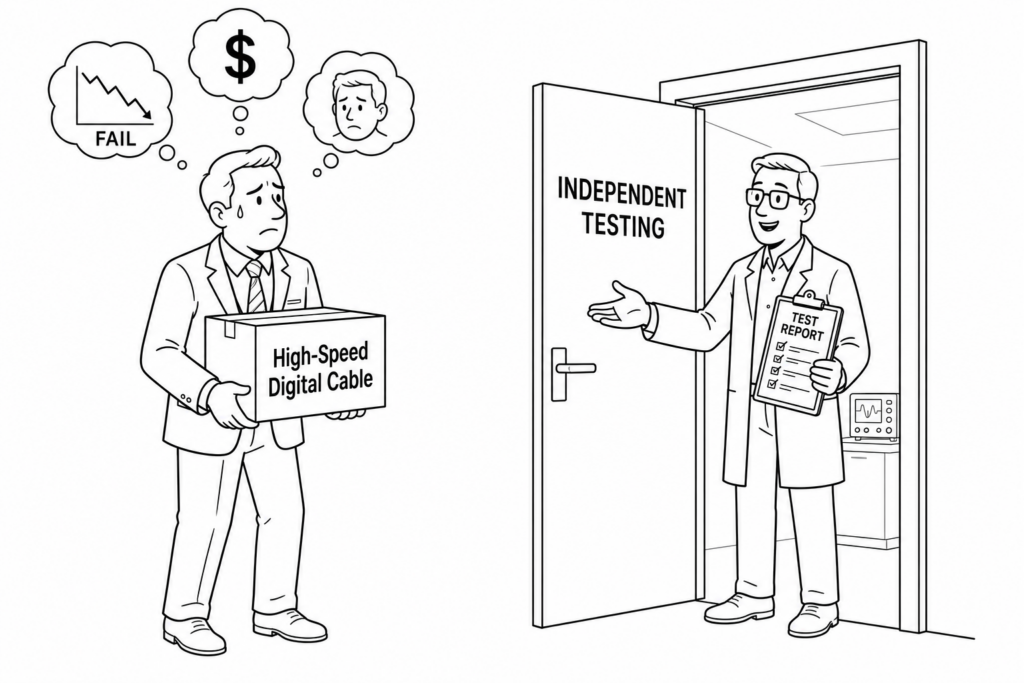
The fears surrounding independent testing, including the fear of failure, financial loss, and reputational damage, contrasted with the welcoming approach of an independent testing laboratory.
Perhaps the greatest misconception surrounding independent testing is the fear of public exposure. Most reputable professional laboratories work to protect and secure any IP closely with manufacturers throughout the engineering and testing process:
Confidentiality agreements (NDA’s) are common, and engineering reports remain private. Failures become learning opportunities for the client rather than public announcements. A laboratory’s objective is improvement, not embarrassment.
In reality, confidential engineering collaboration has helped improve countless products that consumers will never realize once contained significant design issues.
That is exactly how the process supposed to work.
Ironically, these fears do not disappear by avoiding independent testing. They simply reappear later in the marketplace, where the consequences are measured not in laboratory reports but in end users’ dissatisfaction, warranty claims, loss of sales and damaged reputations.
Testing never damages a product’s reputation.
It only adds to it.
Poor performance in the marketplace however does.
DPL Labs has earned a global reputation as one of the most demanding independent testing and certification transmission line laboratories in the world. That reputation has not been built on finding fault with products, but on
helping manufacturers achieve the highest levels of performance possible by incorporating years of experience within this product category. Its success has been driven by companies within this industry that share a common goal: to achieve maximum performance, reliability, and customer satisfaction. Unfortunately, studies have surfaced showing a number of companies that actually embrace this philosophy is disappointingly small.
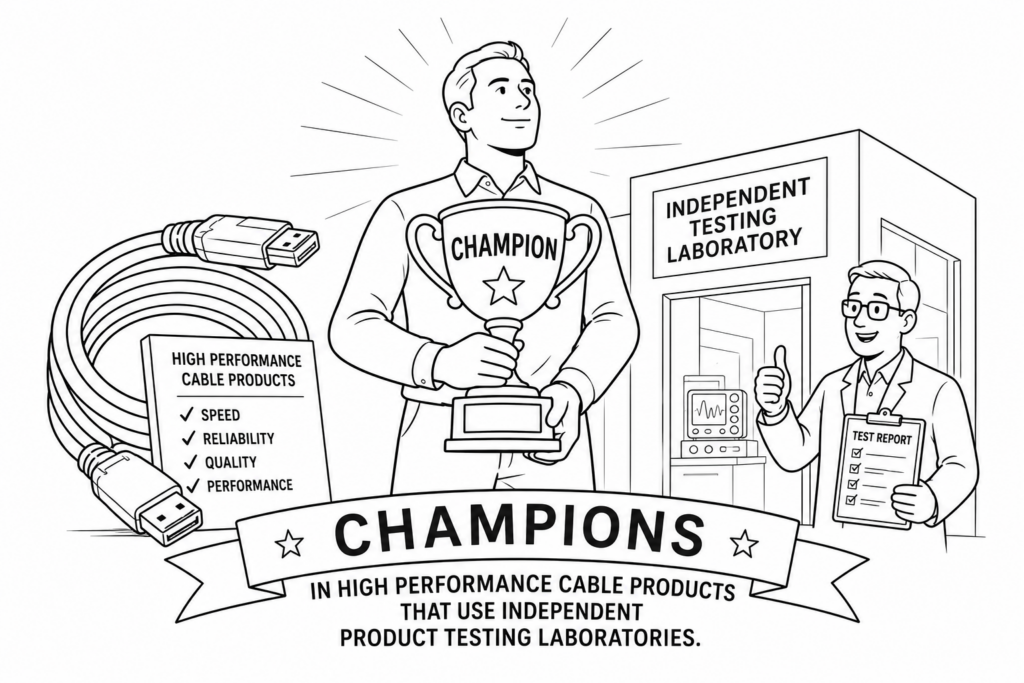
Illustration of a company that has achieved champion status for its high-performance cable products through independent testing.
Over the years, DPL Labs has received inquiries from scores of manufacturers seeking independent evaluation of their high-speed digital signal transmission line products. Most express confidences that their products belong among the Champions of performance and reliability. Yet, when the opportunity arises to validate those claims through comprehensive independent testing, fewer than 20 percent actually proceed to completion. The companies that do accept this challenge deserve recognition. They demonstrate confidence, professionalism and a commitment to ethical business practices by placing sound engineering, measurable performance and product reliability above marketing hype and unsubstantiated claims that cannot be measured or proven. The temptation to simply “check the box.” Their objective is not merely to bring products to market, but to deliver products that consistently perform as promised, exceed customer expectations and earn lasting trust through proven performance rather than promotional claims.
These are the Champions of our industry. They understand that credibility is earned over time by way of a strong focus on research, engineering, objective measurement, and not just advertising or greed by increasing profit margins. They recognize that a laboratory report is far more valuable than a marketing brochure, that engineering data carries more weight than sales rhetoric and that long-term customer satisfaction is built on historical performance and reliability rather than promises. They accept criticism as an opportunity to improve, embrace transparency as a strength rather than a liability and view every engineering challenge as another step toward building a better product. In doing so, they not only strengthen their own brands products and position but also elevate the standards and reputation of the entire electronics industry.
When Specifications Become Marketing
In consumer electronics, specifications are supposed to make products easier to understand. They provide measurable information that allows integrators and consumers to compare one product with another. But something changes when specifications stop being primarily performance information but instead becomes marketing tools.
A specification has value because it can be measured, repeated and independently verified. Once that connection is weakened, a specification can become little more than a carefully constructed statement designed to create an impression of performance without necessarily demonstrating it.
The problem is not that manufacturers promote their products. Marketing is an essential part of any business. The problem occurs when marketing terminology is used to suggest a level of performance that the specification itself does not actually support.
Consider a product claiming
“Supports 48Gbps.”
What does that really mean?
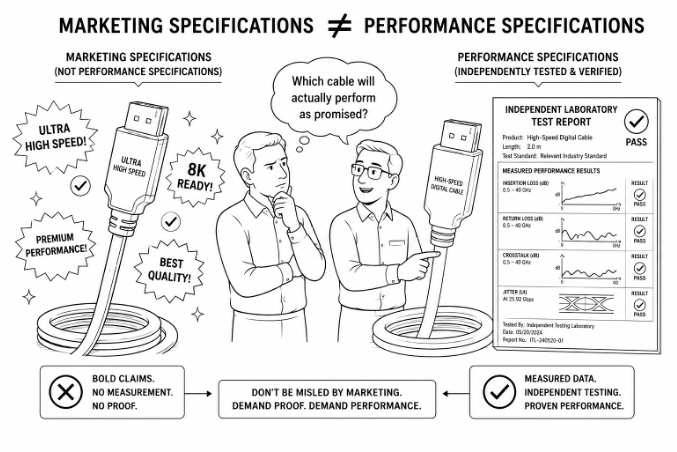
Marketing specifications vs. performance specifications
Does the product pass and support all features in the category including resolutions, audio features, and power and was interoperability even evaluated? Or was the product simply able to establish a connection?
These questions matter because modern consumer electronics have become increasingly complex. A product can appear to work while operating dangerously close to its performance limits. It may pass a basic functional test yet fail when use for specific applications like HDR10 or 4K 120 and there is still the risk of what happens with working along with other manufacturer’s equipment introducing its own set variables. This is how a specification can quietly become marketing, appearing to promise performance that has never actually been demonstrated.
A particularly misleading practice is to build a product claim around an artificial or narrowly defined condition that is difficult, if not practically impossible, for an independent testing laboratory to reproduce and verify. The resulting specification may sound technically credible, creating the impression that the product outperforms competing products under superior operating conditions, when those conditions may have little relevance to real-world use or may not exist at all.
Silent Withdrawals
An interesting pattern has emerged throughout the testing industry. Some companies enthusiastically schedule testing appointments. Engineering samples are discussed. Documentation is exchanged. Schedules are reserved.
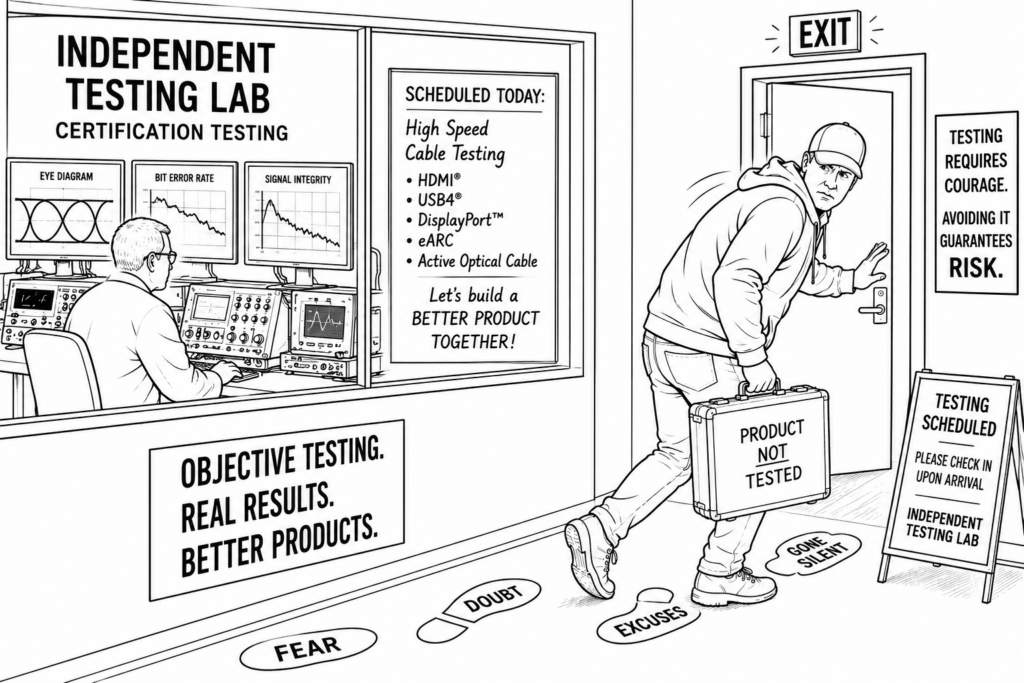
Then the products never arrive. Sometimes communication simply stops. Sometimes explanations involve production delays. Occasionally there are legitimate logistical reasons. However, industry veterans recognize another possibility. The manufacturer may have become concerned about the potential outcome. Rather than risk discovering deficiencies, the easier decision becomes postponement. Eventually postponement becomes cancellation. It’s called Willful Blindness.
Nothing has been learned.
Nothing has been improved.
Yet the products still enter the marketplace Blind as Bat.
Choosing not to pursue that opportunity ultimately shifts the burden of testing from the laboratory to the customer. Instead of discovering problems in a controlled engineering environment, they are discovered in homes, businesses and professional installations around the world.
The companies that embrace objective testing understand a simple truth: every engineering challenge identified in the laboratory is one less problem their customers will encounter in the field. That commitment is not merely good engineering, it is a reflection of corporate ethics, integrity and a genuine commitment to delivering the best products possible.
The companies that become leaders are usually not the ones that never fail a test. They are the ones that are willing to learn from it.
The Products That Never Return
Perhaps even more revealing than the products that never arrive for testing are those that complete the evaluation, receive a comprehensive engineering report and are encouraged to implement corrective improvements before resubmission.
The Champion manufacturers embrace this opportunity. Their engineering teams carefully analyze the results, identify the root causes of performance deficiencies and set out to build a better product. Hardware is refined. Firmware is updated. Components are replaced or optimized. Manufacturing processes are reviewed. For the products that return for retesting, performance improves, and certification ultimately follows. These companies understand that independent testing is not the end of the engineering process. It is an essential part of it.

Group of businesspeople reacting to a poor cable test report.
Unfortunately, not every manufacturer shares that philosophy. After receiving less-than-desirable test results, communication often begins to fade. Scheduled retesting is postponed or quietly abandoned, even though the cost of retesting and engineering support has already been covered. Months later, similar products appear in distribution channels with no indication that the identified performance issues were ever addressed. One cannot help but ask why.
Was the engineering challenge considered too difficult? Were production schedules allowed to outweigh product quality and profit margins? Or did the fear of confronting measurable performance simply become greater than the desire to improve?
Whatever the reason, the consequences eventually shift from the laboratory to the marketplace. Problems that could have been identified and corrected under controlled conditions instead become warranty claims, service calls, product returns and frustrated customers.
One cannot help but wonder how many of those preventable field failures originated from engineering improvements that were identified, understood and ultimately left unfinished. Every product that never returns for retesting represents a missed opportunity – not only for the manufacturer but also for every customer who trusted a brand name product to perform as promised.
Testing Was Never Intended to Embarrass Anyone
Independent laboratories exist for one purpose: to measure performance objectively. Contrary to popular belief, a laboratory does not set out to prove a manufacturer wrong. Nor does it attempt to expose weaknesses for publicity or criticism. A properly operated laboratory follows established procedures, calibrated instrumentation and repeatable methodologies designed to answer one simple question: Does the product perform as advertised under real operating conditions? That answer benefits everyone:
- Manufacturers gain valuable engineering feedback.
- Distributors gain confidence in the products they sell.
- Installers reduce costly field failures.
- Retailers experience fewer product returns.
- Consumers receive products that perform consistently.
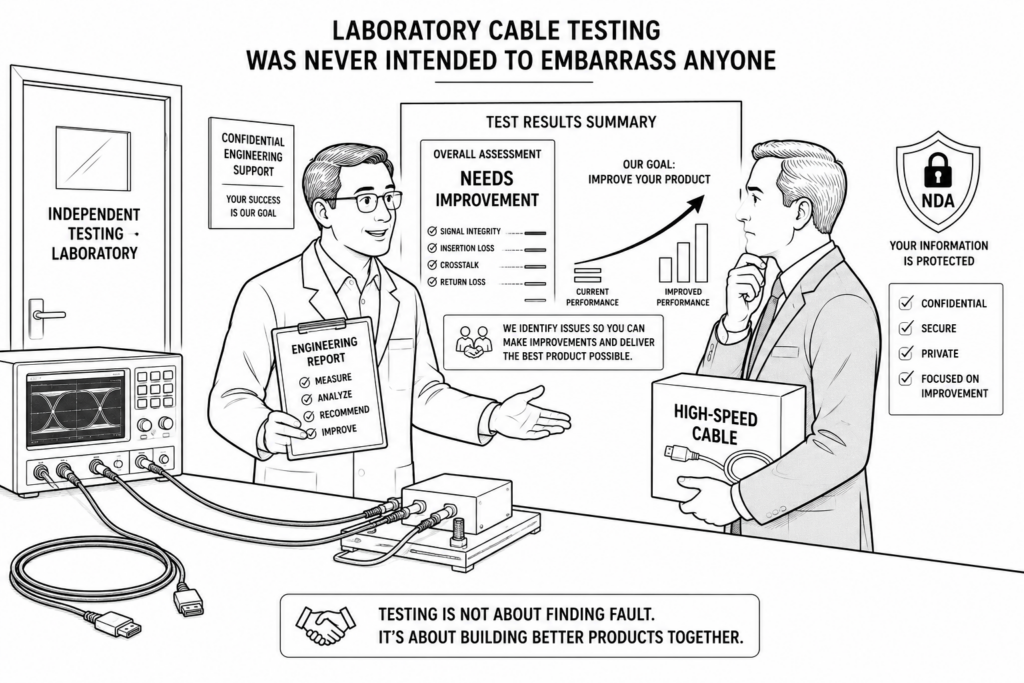
Laboratory cable testing was never intended to embarrass anyone. A collaborative process of cable testing and improvement.
Testing should therefore be viewed as one of the most valuable engineering tools available rather than as an adversary. Unfortunately, perception often differs from reality.
Reputation Versus Reality
One of the greatest concerns among manufacturers is protecting their reputation. Companies spend years, and often decades, building respected brands and earning customer confidence. It is only natural for marketing departments to worry that an unsuccessful independent test could negatively impact that reputation. Ironically, the opposite is often true.
Today’s consumers, professional integrators, and dealers increasingly value transparency over the illusion of perfection. They recognize that the most respected manufacturers are not necessarily those whose products perform flawlessly on the first attempt, but those willing to subject their designs to objective, independent evaluation and continuously improve them. In an era where marketing rhetoric and unsubstantiated claims have become commonplace, credibility is earned through measurable performance, demonstrated reliability, and a commitment to continuous engineering improvement.
Engineering has never been a one-time event. It is an iterative process – a disciplined cycle of design, measurement, analysis, refinement and validation. Every test provides new data. Every design revision brings engineers one step closer to achieving the highest level of performance and reliability. Few, if any, complex electronic products reach their full potential during the first design cycle. The world’s most advanced industries have long embraced this philosophy such as:
The aerospace industry expects continuous testing, redesign and validation before an aircraft is considered certified and ready for service.
The automotive industry continually refines its products through laboratory testing, road testing and real-world performance analysis.
Medical device manufacturers rely on rigorous verification and validation because reliability can directly affect patient safety.
Software developers routinely release updates and enhancements based on testing, customer feedback and newly discovered opportunities for improvement.
Yet, despite these well-established engineering practices, portions of the consumer electronics industry continue to view product revisions as signs of weakness rather than evidence of responsible engineering. Some manufacturers fear that acknowledging a design improvement will diminish customer confidence, when in reality it often demonstrates exactly the opposite. A willingness to improve reflects confidence, accountability and a commitment to delivering the very best product possible.
The strongest brands are not built by avoiding engineering challenges. They are built by confronting them, learning from them and continually raising the standard of performance.
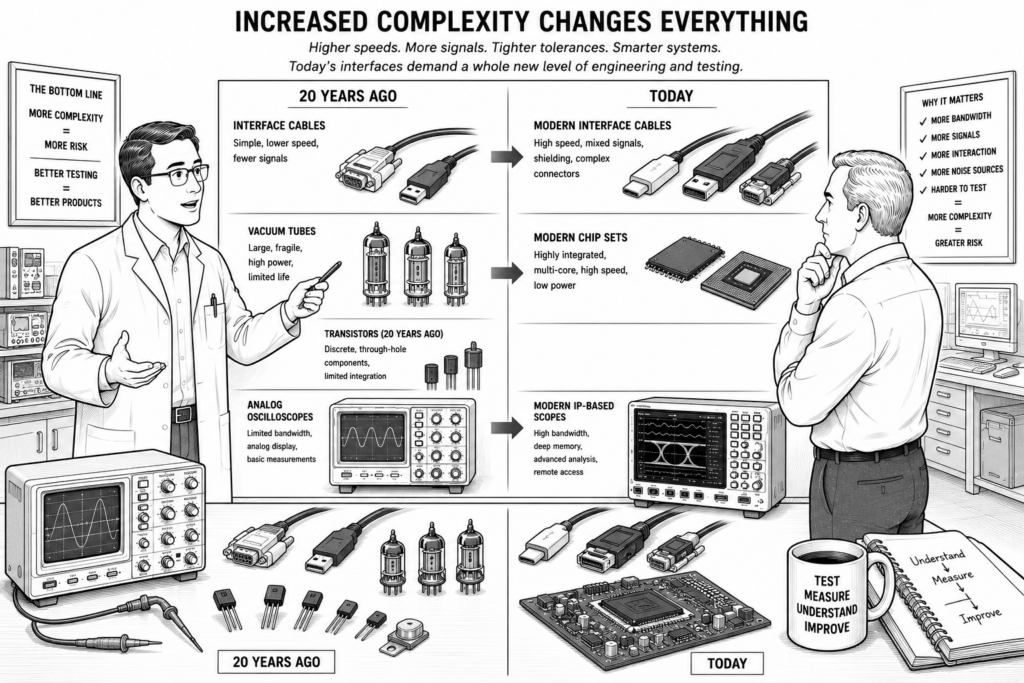
Contrasts the increased complexity of modern electronics with those of 20 years ago, highlighting the need for more rigorous engineering and testing.
Increasing Complexity Changes Everything
Today’s electronic products bear little resemblance to those introduced twenty years ago. Modern interface cables are no longer passive pieces of copper connecting two devices. Many now contain active equalizers, re-timers, optical transceivers, embedded processors, EEPROM memory, power management circuits and sophisticated firmware.
Displays incorporate multiple processors, AI image enhancement, variable refresh rate technologies, HDR processing, networking capabilities and operating systems.
- AVR receivers’ function as computers.
- Projectors perform real-time image analysis.
- Streaming devices receive software updates weekly.
Each additional subsystem creates another opportunity for interoperability issues. A product may operate flawlessly inside its own laboratory yet encounter unexpected behavior when connected to equipment from dozens of other manufacturers. This is precisely why independent interoperability testing has become increasingly valuable.
The Financial Perspective
Independent testing requires an investment. Engineering redesigns can require an even greater one, and production delays may increase costs further. At first glance, avoiding independent testing may appear to be the less expensive path, a mindset where short-term financial thinking can quickly become a costly mistake.
What this approach often overlooks are the far greater downstream costs associated with inadequate product validation, including:
- Warranty replacements.
- Customer support expenses.
- Shipping and logistics costs.
- Returned merchandise and product exchanges.
- Installer labor and service calls.
- Damage to brand reputation.
- Negative online reviews and customer feedback.
- Loss of dealer and distributor confidence.
- Reduced customer loyalty and future sales.
In many cases, the cost of preventing a problem through objective engineering validation is only a fraction of the cost of correcting it after the product reaches the marketplace.
These expenses frequently exceed the original cost of engineering validation many times over.
Independent testing should therefore be viewed not as an expense but as inexpensive insurance against significantly larger financial risks.
Certification Is Not the Finish Line
Many manufacturers mistakenly view certification as the ultimate goal. In reality, certification simply confirms acceptable performance at a particular point in time. Engineering never stops. Component suppliers constantly change. Firmware evolves. Standards advance. Interoperability expands. Consumer expectations increase. Continuous validation should therefore become part of an ongoing engineering philosophy rather than a one-time achievement.
This is where the Champions live and understand this very well.
Building Consumer Trust
Consumers rarely see laboratory reports. They may never understand eye diagrams, jitter measurements, bit error rates or protocol timing analysis. What consumers do recognize is reliability. Products that simply work. Systems that connect immediately. Displays that remain stable. Audio that performs consistently. Installations requiring fewer service calls. This reliability is rarely accidental. It is usually the result of disciplined engineering supported by thorough validation. Testing therefore contributes directly to customer satisfaction even though consumers may never realize the effort behind it.
Conclusion
The fear of product testing is understandable but ultimately misplaced. Testing does not create engineering problems, it reveals them. Ignoring objective measurement has never improved a product. Avoiding independent evaluation has never increased reliability. Engineering advances because weaknesses are identified, understood and corrected. Throughout the global electronics industry, manufacturers face a choice.
One path relies upon assumptions, marketing claims and hope that products will perform successfully in the field.
The other embraces measurement, transparency and continuous improvement through independent validation.

The Ethical Choice: Delivering on the Promise to the Consumer.
Organizations such as DPL Labs have demonstrated through the testing of countless cable products and electronic systems that independent evaluation is not about finding failure. It is about finding opportunity. Every unsuccessful test identifies a path toward a better product. Every engineering correction improves the customer experience. Every successful retest strengthens confidence throughout the supply chain. The companies that ultimately lead the electronics industry will not be those that avoid testing. They become the ones that welcome it.
Because in engineering, the objective has never been to prove perfection.
The objective has always been to pursue it!