


HDMI’s Enhanced Audio Return Channel (eARC)
Detailed Technical Exploration
The evolution of HDMI has always been rooted in a demand for greater bandwidth, improved interoperability, and seamless integration for both video and audio. As display resolutions advanced from 1080p to 4K and now to 8K, the audio domain demanded a parallel leap in fidelity and transport integrity as well. The introduction of the Enhanced Audio Return Channel (eARC) under HDMI 2.1 represents that leap, reengineering how Ultra-High-Fidelity-Audio traverses the interface between displays and AV receivers or soundbars. Unlike the o riginal Audio Return Channel (ARC) introduced with HDMI 1.4, which relied on a lower quality clock and shared pathways with the Consumer Electronics Control (CEC) bus, eARC uses a dedicated data channel that transforms the reliability, bandwidth, and timing behavior of digital audio transmission.
But First, let’s briefly revisit ARC
The Audio Return Channel, abbreviated as ARC, was introduced in HDMI Specification Version 1.4 as a means to simplify audio connectivity between display devices and external audio systems such as AV receivers and soundbars. Its core purpose is to eliminate the need for a separate stereo audio cable or a S/PDIF interface by enabling digital audio to travel in the reverse direction over the existing HDMI link from the display back to the source device. Great idea!
From a physical standpoint, ARC operates on a portion of the HEAC (HDMI Ethernet and Audio Return Channel) differential pair, which consists of pin 14 (HEAC+)  and pin 19 (HEAC– & HotPlug) within the HDMI connector. Under normal circumstances, this is configured as a differential pair reserved for the optional HDMI Ethernet Channel. When ARC is active, that same pair is reassigned to carry a single-ended, common-mode audio signal rather than two differential Ethernet data channels. The signaling method used is derived from the IEC 60958 standard, the same physical layer specification that governs conventional S/PDIF interfaces.
ARC supports compressed multi-channel digital audio formats such as Dolby Digital, DTS, and MPEG-2 AAC, with a data rate approximately 3 Mbps, sufficient for up to 5.1 channels of encoded sound. It does not support uncompressed high-bitrate audio such as Dolby TrueHD or DTS-HD Master Audio. These limitations would later motivate the creation of Enhanced ARC (eARC) in HDMI 2.1.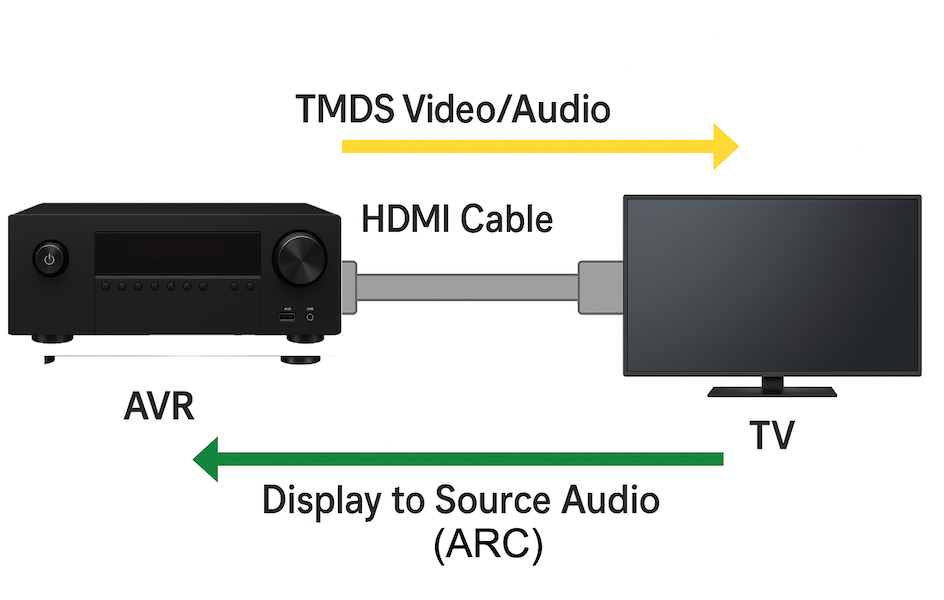
Electrical control of ARC is not autonomous; instead, its activation and configuration are handled through the Consumer Electronics Control (CEC) protocol. The CEC bus carries the logical commands that instruct both devices to switch the HEAC pair from Ethernet mode to Audio Return mode. The source device, often an AV receiver, includes a S/PDIF receiver circuit adapted to sense and decode the ARC waveform, while the display implements a corresponding S/PDIF transmitter stage to drive the signal up stream.
ARC’s timing structure is derived from its sampling rate and functions independently of the TMDS video data channels. Both source and display devices synchronize using the audio’s own sampling rate of 44.1 kHz and 48 kHz. This separation ensures that audio continuity is maintained even as the video stream changes resolution or refresh rate. The relatively modest bandwidth and legacy transport method make ARC highly compatible with standard copper HDMI cabling, although long-run copper or fiber active-cable designs can occasionally expose performance losses or integrity issues that can affect ARC reliability.
HDMI’s Audio Return Channel represented an elegant early attempt to streamline audio interconnects in digital home systems by utilizing an existing physical channel within the HDMI interface. While its bandwidth and protocol design are constrained by legacy S/PDIF principles, ARC laid the foundation for the far more robust eARC implementation that followed, which re-engineered the channel’s physical and logical layers to support modern uncompressed audio formats and greater interoperability.
The Evolution from ARC to eARC, a True Bandwidth Renaissance
At the core of eARC’s architecture is its physical and logical independence from the TMDS and FRL lanes that carry video and auxiliary data. It operates instead over the pair of wires originally assigned to the HEAC (HDMI Ethernet, Audio Return Channel and HotPlug). In the ARC model, this pair was a shared bidirectional half-duplex medium limited to compressed audio streams such as Dolby Digital or DTS. With eARC, this same twisted pair becomes a full-duplex, dedicated high-speed audio link, capable of handling uncompressed, multichannel PCM and high-bit-rate lossless formats such as Dolby TrueHD and DTS-HD Master Audio. The eARC data rate increases from <-3 Mbps under ARC upwards to 37 Mbps LVDS (Low Voltage Differential Signaling) for eARC, with a Unit Interval (UI) of 27 ns opening the door to 192 kHz, 24-bit, eight-channel uncompressed audio with beaucoup headroom to spare. Compared to TMDS eARC’s signaling method deferrers substantially by using Common Mode logic (CML) with nominal swings of 400 to 600 mVpp where in contrast eARC’s LVDS differential swing is approximately 350 mVpp centered around a common mode
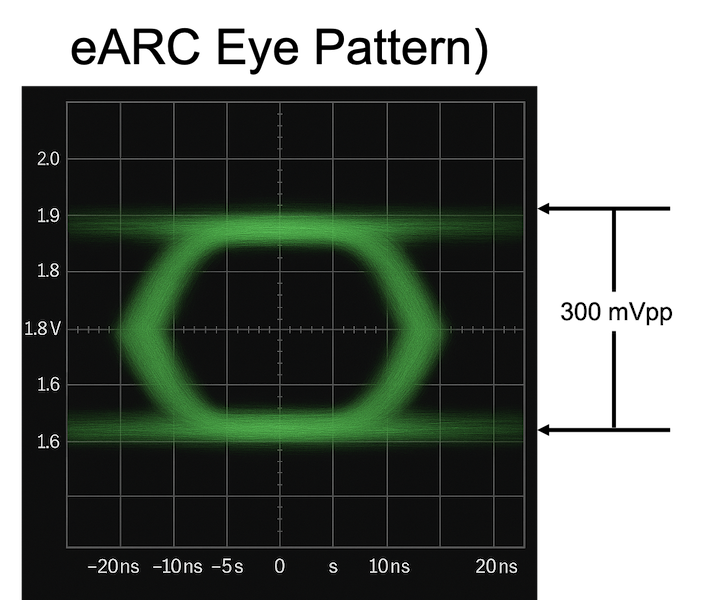 voltage of 1.8v. This choice is deliberate: it keeps the power low while maintaining high noise immunity across longer copper runs and through repeater devices. The differential pair operates with DC coupling to enable link training sequences and low-frequency data components needed for synchronization and clock recovery.
When considering HDMI 2.1 FRL (Fixed Rate Link) operation where it can push other video lanes above 10 GHz, electromagnetic isolation between eARC and FRL lanes is essential. HDMI cable manufacturers typically employ foil and braid shielding around the eARC pair, sometimes with separate drain wires to minimize common-mode coupling. The isolation must maintain at least 60 dB attenuation at 1 GHz to ensure that the eARC control frames are not corrupted by any harmonics.
The maximum allowable skew between the two lines of the differential pair is less than 50 ps. Excessive skew translates directly into eye closure at the receiver and loss of deterministic timing, particularly because eARC’s high-speed clock recovery uses the data stream itself rather than an embedded separate clock. The data rate, while only a fraction of FRL’s multi-gigabit speeds, is still high enough to be sensitive to phase mismatch.
eARC’s nominal differential impedance is identical to both the TMDS and FRL lanes for the high-speed video. Its return loss typically exceeds 15 dB at 50 MHz, ensuring minimal reflections. Crosstalk isolation of at least 25 dB is mandated between the eARC differential pair and any adjacent TMDS lanes. This becomes especially critical in hybrid active optical cables (AOCs), where the eARC pair remains copper while the TMDS pairs are converted to optical, making the analog design of that copper return channel pivotal for compliance.
Robust Synchronization Across Complex HDMI Topologies
Beyond raw bandwidth, eARC’s most significant engineering achievement lies in its disciplined approach to clock recovery and system timing. ARC’s dependence on asynchronous timing frequently introduced clock jitter, drift, and misalignment between the source and sink, leading to audible distortion and persistent lip-sync anomalies. eARC resolves this by establishing a deterministic timing model built around a forward master clock transmitted from the display to the audio device. This dedicated clock lane stabilizes the timing domain and eliminates the ambiguity that plagued ARC’s recovery schemes, ensuring bit-accurate rendering of high-resolution PCM and lossless object-based streams. To maintain timing integrity through long cable runs and repeater-rich installations, the eARC channel incorporates embedded framing constructs that define packet boundaries, identify synchronization markers, and enforce error detection rules. These structures impose predictable timing discipline across the link, allowing the audio path to remain phase-coherent with the video frame cadence even in complex HDMI topologies.
Autonomous Protocol Governance Without CEC Dependence
The protocol layer of eARC represents one of its most substantial refinements by eliminating reliance on CEC for device discovery, capability reporting, and link management. Instead of depending on the fragile, timing-sensitive behaviors traditionally associated with CEC, eARC introduces a dedicated control data structure transported over the eARC Data Channel. During link training, the display communicates its complete audio profile to the upstream audio device through a structured series of registers that define
supported sampling rates, maximum channel counts, and codec compatibility. These descriptors originate from an expanded E-EDID Audio Data Block, now capable of enumerating advanced audio formats such as Dolby Atmos and DTS:X with precision. Because this negotiation is entirely autonomous and independent of CEC, full eARC interoperability can be achieved even in systems where CEC is disabled, inconsistent, or non-functional, ensuring that capability exchange remains deterministic and resilient across all device combinations.
In addition to the main data path, eARC defines a secondary control subchannel called the eARC Data Channel (eARC DC). This operates at a lower data rate, typically under 1 Mbps and carries link management, status, and capability exchange information. Electrically, it is superimposed on the same differential pair but uses a distinct modulation scheme and time-domain multiplexing controlled by initialization state machines. During the link training phase, the channel transitions between low frequency signaling (used to establish link integrity and negotiate capabilities) and high-speed differential signaling once the audio path is active.
Signal Integrity Requirements of the HEAC Differential Pair
From a signal integrity standpoint, eARC relies on cable assemblies and termination schemes that conform precisely to the electrical profile of the HEAC infrastructure. The differential pair allocated for eARC must maintain a tightly controlled impedance, normally centered around 100 ohms, across the entire length of the cable and through all connector transitions. Modern eARC-capable receivers incorporate active front-end circuits that participate in link-training routines designed to validate this impedance environment, confirm the continuity of the pair, and detect improper DC biasing or asymmetry. These procedures help stabilize performance even in systems longer cables where impedance irregularities can otherwise compromise the differential mode audio stream. Although the DDC link remains active for legacy EDID communication, it operates independently of the eARC control and audio channels to prevent crosstalk and timing interference. The deliberate separation of these signaling domains, combined with the impedance and shielding standards enforced through Ultra-High-Speed HDMI specification, ensures that FRL video data and eARC audio transport coexist reliably within the same physical cable.
Power Integrity as a Determinant of eARC Link Establishment
One subtle but significant feature of eARC is its automatic fallback mechanism. When an eARC-capable device connects to a non-eARC receiver or display, the system reverts to standard ARC operation through its discovery signaling sequence, preserving backward compatibility and allowing integrators to deploy mixed HDMI topologies
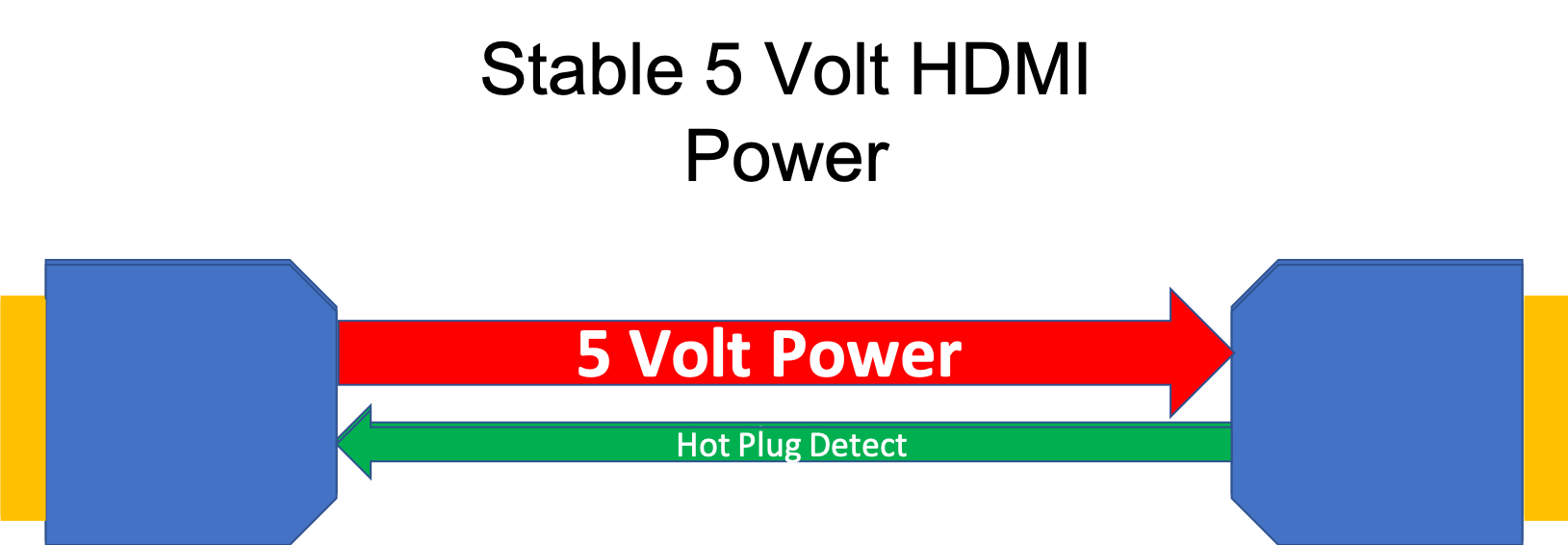 without risking a total loss of return audio. The reliability of this process, however, is determined largely by the integrity of the Hot Plug Detect line and the +5-volt power rail, both of which communicate link readiness and capability between the source and sink. Because eARC depends on precise voltage thresholds and timing behavior for its initial handshake, even minor power irregularities, such as voltage drop, rail instability, or insufficient current delivery in long active optical cables or low-quality passive assemblies, can prevent eARC mode from engaging. This makes clean 5-volt regulation and proper cable power management essential design considerations for achieving consistent, deterministic eARC performance in modern systems.
From ARC to a True High-Performance Audio Link
The integration of eARC into system designs also changes how AV receivers and processors handle audio routing. In legacy ARC systems, the television was the source of the audio stream, sending it “backward” along the same HDMI cable that delivered the video downstream. In an eARC configuration, the TV’s internal tuner or streaming apps still serves as the source, but now they can output full high-resolution audio with no compression or down sampling. This enables a television running Netflix, Disney+, or a Blu-ray app deliver Dolby TrueHD with Atmos metadata directly to a receiver or processor for bitstream decoding. The HDMI specification ensures that these high-bandwidth audio packets are delivered asynchronously from the video channel, allowing independent optimization and guaranteeing that full-resolution audio accompanies every frame, even under heavy video loads. These advancements can very likely change the entire audio system make up to audio reproduction with reference grade listener.
Synchronizing Audio and Video in the eARC Era
The introduction of eARC also addresses the challenge of audio/video synchronization that has long plagued HDMI-based systems. Lip-sync errors can occur  when video processing latency outpaces or lags behind audio playback. HDMI 2.1 mandates that all eARC devices support automatic lip-sync compensation through metadata exchange, allowing the sink to report its video latency to the source, which then adjusts audio delay accordingly. This eliminates any manual sync adjustments integrators often performed on receivers or processors. It represents one of the most practical quality-of-life improvements in HDMI 2.1 and directly impacts consumer experience.
Topology Constraints and Distribution Strategies for eARC
In multi-zone and professional integration environments eARC introduces a new set of design considerations. Because it is a point-to-point link between a single source and sink, it cannot be distributed or switched using  conventional HDMI matrix routers unless those devices include dedicated eARC relay or passthrough functionality. This limitation is particularly important for large installations where central video switching is employed. Integrators may need to implement eARC extractors or separate audio distribution systems to maintain lossless audio paths when video routing diverges. Some manufacturers have begun exploring these solutions by embedding eARC signal regeneration and clock recovery circuits within extenders and matrix chassis to maintain compliance with the HDMI 2.1 eARC specification.
The broader implications of eARC extend well beyond consumer home theater and into territory traditionally occupied by professional audio networks. As HDMI increasingly unifies high-speed video transport with multichannel audio delivery, eARC introduces a physical and logical framework that closely mirrors audio-over-IP architectures such as AES67 and Dante, while remaining native to the consumer HDMI ecosystem. Its deterministic timing behavior, substantial bandwidth capacity, and packetized control structure establish the groundwork for future evolutions in which HDMI functions not merely as a display interface, but as a comprehensive digital backbone capable of distributing tightly synchronized audio and video across multi-room environments.
In essence, eARC marks a transition from convenience-oriented ARC to a fully engineered, high-integrity digital audio transport system. Its independence from CEC, robust clocking, higher data throughput, and automatic lip-sync compensation create a reliable, lossless link between displays and audio processors. As source devices and displays continue to evolve, eARC stands as one of the most critical underpinnings of HDMI 2.1, an invisible but essential bridge ensuring that the visual fidelity of 8K video is matched by equally uncompromised high-performance audiophile hardware.
Cable Power and DC Bias Considerations
The eARC pair maintains a DC coupled application which allows the sink device to sense presence and polarity even before the eARC link initializes. For this reason, HDMI 2.1-certified cables must ensure less than 5 Ω DC resistance per conductor and strict  symmetry between the two legs of the pair. The presence of DC bias also allows link-detection logic to function correctly even when the HDMI 5 V supply (on pin 18) sags slightly, a common issue that can disrupt eARC negotiation on marginal cables or long AOC designs.
Summary of Key Electrical Attributes
In pure electrical terms, eARC is best characterized as a low-voltage, DC-coupled, 100 Ω differential communication channel with tight control of impedance, low skew, high immunity to interference, and a dedicated clock recovery scheme. Its electrical robustness allows it to transport lossless, multi-channel digital audio over distances that would render legacy ARC unreliable or distorted.
In high-performance installations, especially those involving long hybrid copper/fiber HDMI assemblies, maintaining eARC compliance depends on controlling cable impedance, DC resistance, and ground symmetry. When these conditions are met, the eARC link becomes as electrically stable as any professional AES3 or LVDS differential transport system, allowing uncompromised high-resolution audio to coexist alongside 48 Gbps video on the same HDMI interface.