


Why is eARC Suddenly Taking Off?
For years, HDMI® eARC was one of those features that appeared on specification sheets but rarely generated much excitement and little use. It was there where it worked in the background and for many consumers there was little reason to understand what it actually did.
That’s changing Big Time!
There is now a noticeable increase in interest surrounding HDMI® eARC and consumer electronics manufacturers are highlighting it. High Performance Audio Systems and soundbars routinely include it. Television manufacturers prominently identify on their eARC ports. Consumers are asking questions about it and integrators have begun to embrace it. And perhaps most importantly, eARC is increasingly becoming part of the expected signal path in today’s home entertainment systems.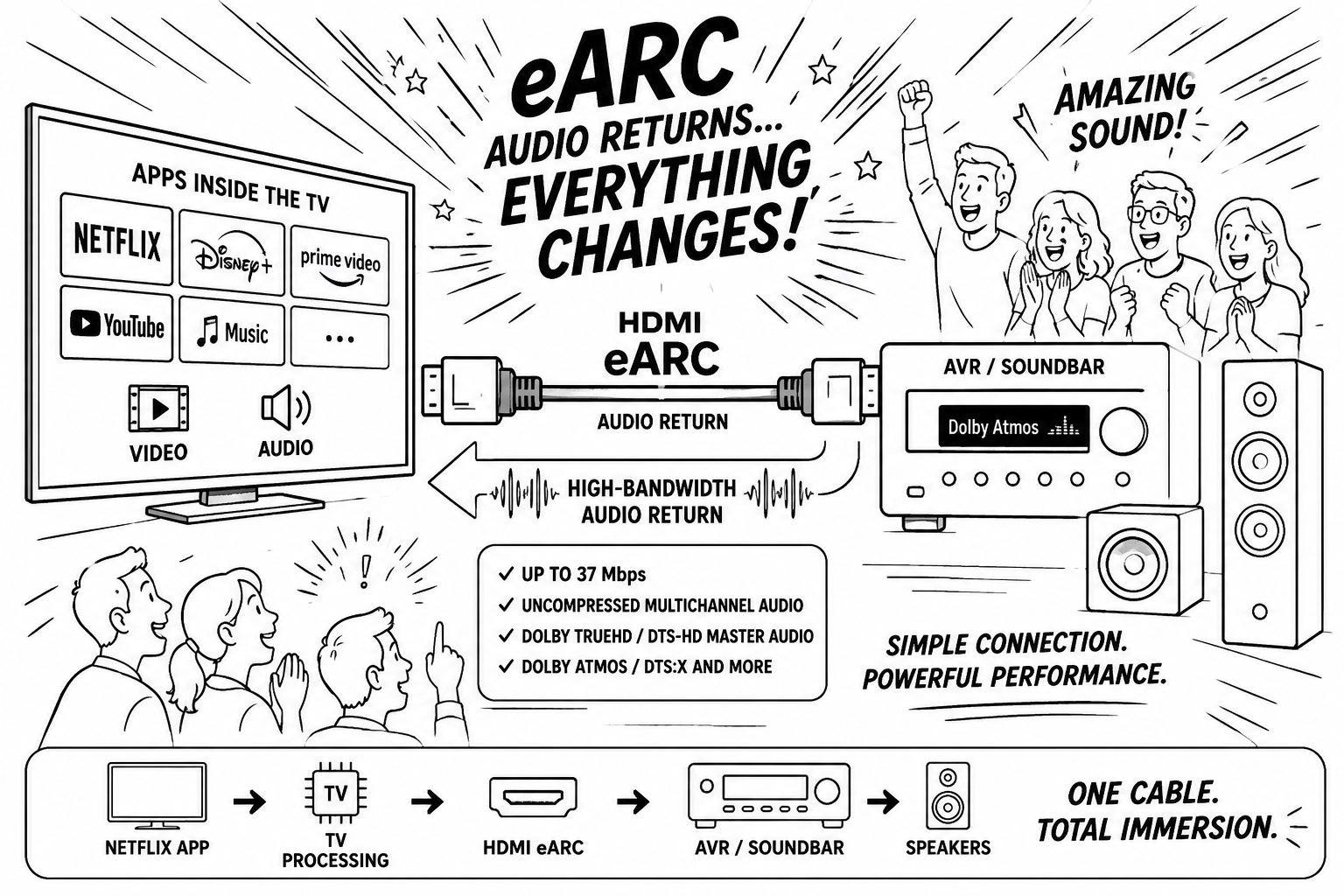
So, what changed?
The answer has less to do with eARC itself and much more to do with the way we are consuming entertainment. Our Televisions have become a high-performance audio source. The traditional home theater signal path was relatively simple. A Blu-ray player, cable box, satellite receiver or game console sent its audio and video to some form of input switching and audio amplification. The receiver processed the audio to its high-performance speakers and passed the video along to the display. The audio electronics became the center of the system.
That traditional model has been turned completely upside down…
Today’s Television can be considered both a source and a sink, including inputs, outputs, and a litany of goodies (apps). Netflix, Disney+, Prime Video, Apple TV+, Tubi, Pandora, and Spotify, to name a few and now run directly from applications built into the Television. This represents a fundamental transformation from a device that primarily received video from an external source to a sophisticated platform that generates and processes entertainment content at nearly every level.
Streaming influenced the importance of eARC.
With that transformation came a significant challenge.
“How do you get the audio generated by the apps inside the Television back to the sound system while maintaining the same level of performance that our High-Performance Audio Systems delivered in the past?”
Initially a collection of audio cables, some at relatively long lengths, along with additional connections from conventional sources that traditionally been connected to our audio systems like Pre-Amps, Power Amps and AVR’s as an example. This is where ARC (Audio Return Channel) came into the picture. ARC allowed the television to send audio back through the HDMI® connection to a sound system or soundbar. It was a clever solution that eliminated the need for a separate analog audio cables and optical or digital audio connections. But ARC had limitations. ARC was never designed for today’s audio expectations. Standard ARC provides relatively limited audio bandwidth. It is adequate for stereo and compressed surround formats such as Dolby Digital, but it becomes restrictive when the objective is to transport higher-performance audio including formats such as Dolby Atmos.
eARC changed that equation dramatically.
Under HDMI® Rev 2.1 eARC increases the available audio bandwidth to approximately 37 Mbps. That is enough to support uncompressed multichannel audio, Dolby TrueHD, DTS-HD Master Audio and the immersive audio formats associated with Dolby Atmos, DTS:X and uncompressed 5.1/7.1. Suddenly, the television had entered the high-end audio arena, offering audio capabilities that once were found only in the most sophisticated and high-performance audio system products. What had traditionally been viewed primarily as a display had now become a capable component in the audio signal chain.
That distinction has become increasingly important as consumers come to expect their Television to serve as the central hub of the home entertainment system.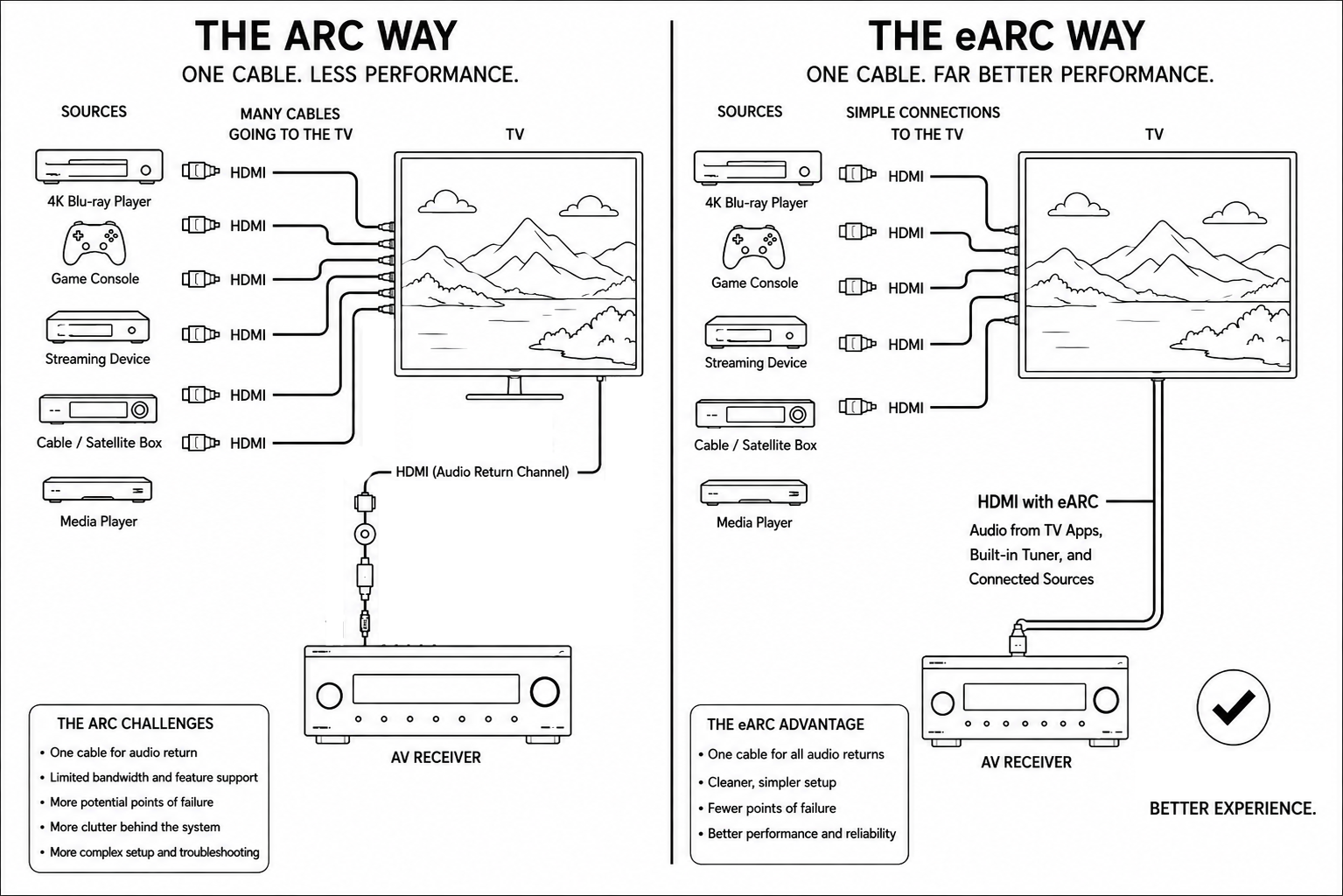
This may be the biggest reason for the renewed interest. Consider a modern television with Netflix running internally. The video never leaves the Television as a conventional HDMI® source. Netflix, for example, is an application running directly inside the television. The television receives, decodes and processes the stream, producing both audio and video. The video goes directly to the screen. But where does the audio go? If the television is connected to a high-performance audio system or soundbar through its eARC connection, the television can send that audio back through the same HDMI® cable to the audio system. This effectively eliminates the need for separate audio or optical cables running back to the Television. More importantly, it provides a digital audio path capable of maintaining the performance expected from today’s high-end audio systems without many of the limitations and signal degradation concerns associated with the analog audio cables traditionally used in these systems. The signal path is therefore fundamentally different from the traditional home theater model as an example :
Netflix app → TV processing → HDMI eARC → Audio System → speakers.
That simple change has made eARC considerably more relevant. rtings.com has highlighted the growing importance of this architecture, noting that the widespread adoption of Smart TVs with applications such as Netflix, Prime Video, Spotify, Pandora, Disney+ and Apple TV has created a much greater incentive to connect televisions directly to dedicated audio systems.
In other words, the Television has become both the display and the source. eARC has become the high-performance audio highway, providing the path from the Television’s internal content to an external audio system and bringing an immersive audio performance to the forefront of the modern home entertainment experience. In addition, Dolby Atmos immersive audio helped push eARC into the spotlight totally changing the conversation. Dolby Atmos has moved from being primarily associated with expensive home theater systems and Blu-ray discs to becoming a featured consumer encounter routinely on streaming services. That creates a marketing opportunity for manufacturers.
“4K” became a familiar consumer term. “HDR” followed. “120 Hz” while “VRR” became important to gamers. Now “Dolby Atmos” identifiers are increasingly appearing on televisions, soundbars and high-performance audio systems.
There is a significant difference between compressed Dolby Digital Plus-based Atmos commonly used by streaming services and lossless Dolby TrueHD-based Atmos used in higher-quality applications such as Ultra HD Blu-ray. eARC provides the bandwidth required for these higher-performance formats. Sony, for example, specifically identifies eARC support for uncompressed 5.1 and 7.1 audio as well as Dolby Atmos, DTS:X, DTS-HD Master Audio and Dolby TrueHD. This makes eARC much more than a convenient replacement for an audio or optical cable. It becomes part of the architecture required to move high-quality audio from the television to the audio system.
But there is an important misconception about the cable
One of the most interesting aspects of eARC is that its return path is achieved by way of the HDMI® HEAC differential pair, the same pair originally associated with the HDMI® Ethernet Channel. By repurposing this 200 MHz differential channel for eARC, HDMI® provides sufficient bandwidth and overhead to support an impressive range of high-performance audio formats, including:
• Dolby Digital Plus with Atmos.
• Higher-bitrate Dolby Digital Plus with Atmos
• Dolby TrueHD with Atmos
• Dolby Mat with Atmos
This illustrates an important point: eARC’s 37 Mbps capacity is not simply a large number on a specification sheet. Some audio formats consume less amounts of that available bandwidth, with the most demanding formats pushing eARC to its bandwidth limits.
Sony specifies eARC at up to approximately 37 Mbps and recommends a High-Speed HDMI cable with Ethernet (HEAC) to achieve eARC requirements. This is an area where cable marketing becomes particularly interesting.
eARC May Be the Next “Hidden” HDMI® Cable Challenge
eARC adds another important element to that equation. As its adoption increases, we should expect more attention to move from simply asking whether a cable product “supports eARC” to asking if the product was verified and immune from interoperability issues. That distinction matters. Marketing can tell us that a product has eARC, but that alone does not confirm how well the complete system will perform when a television, streaming application, HDMI cable, audio system or soundbar and multiple HDMI sources perform when connected together. Ultimately, it comes down to interoperability and the testing required to substantiate the marketing claim. A product may include an Ethernet channel within the cable itself, yet that does not necessarily mean it has the necessary bandwidth and overhead to handle all of eARC functions.
A cable can be perfectly functional for a particular video application yet still present questions when the complete HDMI® link is evaluated as a system. That is especially relevant as HDMI® systems become increasingly complex.
Timing is significant
The renewed interest in eARC is not happening in isolation. HDMI® 2.1 features have now been in the market for several years and have moved from premium products into much broader portions of the consumer market. HDMI® itself noted in 2025 that HDMI® Rev 2.1b products had become widely available and more affordable while highlighting eARC as an important component of today’s audio-video systems.
At the same time, manufacturers continue to introduce new Audio and Video electronics designed around 4K/120, 8K, Dolby Atmos, streaming and eARC. Yamaha’s 2026 receiver introductions, for example, explicitly position these capabilities as part of today’s mainstream home theater experience.
The real story is not eARC
Perhaps the most interesting conclusion is that the sudden interest in eARC is not really about eARC. It is about the changing architecture of home entertainment.
The Television has evolved from being primarily a display into a central entertainment platform. The streaming application has replaced the set-top box for many consumers. The soundbar replacing the traditional multichannel receiver and speaker system in many homes as well.
Immersive audio has become a mainstream feature rather than a specialty capability. And HDMI® has become the connection tying all of these elements together. In that environment, the audio return path is no longer a secondary convenience. It has become a critical part of the system. That may explain why eARC, after years of quietly sitting in the background of HDMI® specifications, is suddenly getting so much attention. The industry may have finally reached the point where the return path matters as much as the forward path. And that raises an important question for manufacturers, cable brands, integrators and test laboratories:
If eARC is becoming a critical part of the HDMI® signal path, are we testing it with the same rigor that we apply to the video path?